Toilet Bowl Cleaners for Septic Systems: What's Worth Using
Last updated:
You're in the cleaning aisle with a bottle in one hand and your phone in the other, trying to work out whether this stuff is going to cause trouble in the tank out back. Here's the short version. Use as little bleach as the job needs, skip the drop-in "every flush" products, read the full ingredient list, and keep your tank on a pumping schedule, because no cleaner replaces that.
We make a toilet bowl cleaner for septic homes, and we'll tell you where it fits. We haven't lab-tested every brand on the shelf, though, so we're not going to pretend to rank them.
Why your toilet cleaner matters when you're on septic
Everything you flush ends up in the tank. A septic system does its work quietly, and it does it best when its natural balance isn't upset. That's why the University of Minnesota's septic program tells homeowners to use "minimal amounts of mild cleaners as needed only." EPA's SepticSmart guidance makes a similar point about clogs: skip chemical drain openers and reach for boiling water or a drain snake instead.
None of that means you can't keep a clean bathroom. It just means the toilet cleaner is one of the few products that goes straight into the tank every single time you use it. Thirty seconds of label reading is worth it.
What to look for on the label
- Every ingredient listed. If a brand won't tell you what's in it, you can't judge it.
- Little or no chlorine bleach. Minnesota's septic program says to use "the minimum amount of soap, detergent and bleach necessary to do the job."
- Mild over harsh. The same program asks homeowners to cut back on harsh cleaners and do "more scrubbing with less cleanser."
- No drop-in "every flush" products. Minnesota's program advises against toilet bowl products that sit in the tank or bowl and release with each flush.
- Plant-based or biodegradable surfactants. Surfactants are the ingredients that lift grime off the porcelain. You'll usually see them named on a full ingredient list.
- Clear directions, so you know how much to use and how often.
And "septic safe" on the front of the bottle? Treat it as a starting point. We couldn't find a single federal standard that defines that phrase for liquid or powder cleaners, so the ingredient list on the back tells you more than the claim on the front.
The main types, side by side
| Type | What's usually in it | What it's good at | What to watch on septic |
|---|---|---|---|
| Gel or liquid | Surfactants, thickeners and fragrance. Some add bleach or acid. | Clinging under the rim | Check the ingredient list, since some gels add bleach. |
| Oxygen powder | Sodium percarbonate, which releases oxygen in water | Brightening stains | Use the amount on the label. Our ingredient guide covers sodium percarbonate. |
| Baking soda and citric acid packets | Baking soda, citric acid, a surfactant, fragrance | Fizzing, no-mess, pre-measured | Read what else is in it. A packet you use when you clean isn't the same as a drop-in tank tablet. |
| Chlorine bleach cleaners | Sodium hypochlorite | Whitening | Use the least that does the job (University of Minnesota). |
| Heavy-duty acid cleaners | Strong acids aimed at mineral rings | Hard-water and rust rings | Minnesota's program asks septic owners to cut back on harsh cleaners. Save these for the rare tough job. |
| Drop-in "every flush" products | Varies by brand | Hands-off | Minnesota's program advises against them. |
| Baking soda and vinegar (DIY) | Just that | Light weekly cleaning, and it's cheap | Mild, and that fits Minnesota's advice to use mild cleaners sparingly. |
Where Flushy fits (and when something else might suit you better)
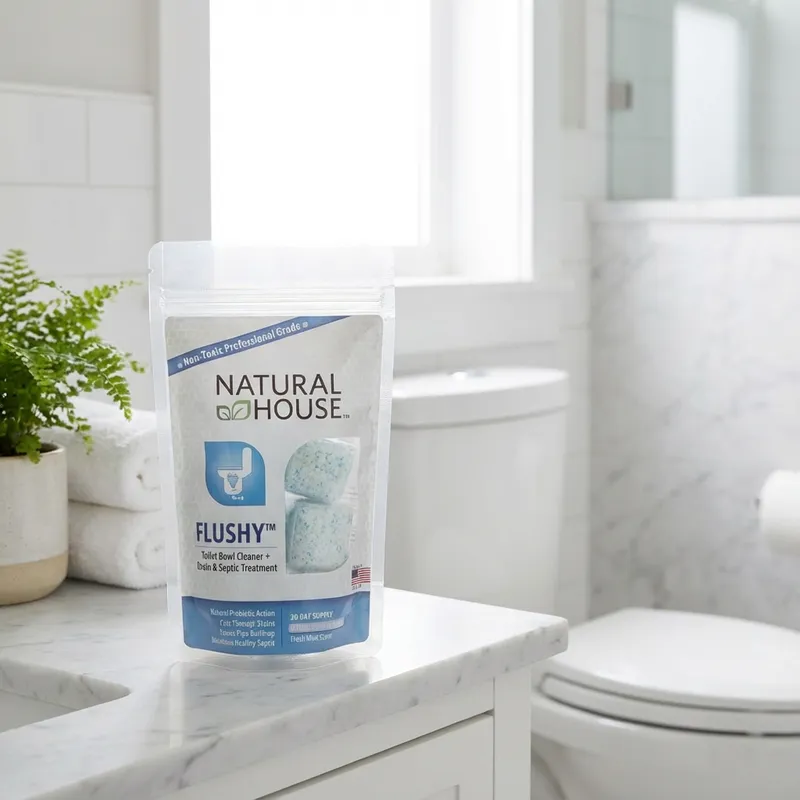
Flushy toilet bowl cleaner packets are what we make for this job, and they're made with septic homes in mind. Each one is a foaming, water-soluble packet. Here's everything in it, straight from our label:
- Sodium bicarbonate (baking soda)
- Citric acid (citrus-based cleaner)
- Probiotic Bacillus blend
- Plant-based surfactant (cleaner)
- Citrus and mint botanical extracts (fragrance)
- Mineral-based coloring
No chlorine bleach and no strong acid. Flushy breaks down the residue that causes odor, cleans the bowl and leaves the water a clean aqua blue. It's septic-system safe, so it won't disrupt your septic tank's natural balance.
Would something else suit you better? Maybe. If you'd rather mix your own, baking soda and vinegar costs next to nothing. If you like a gel you can aim under the rim, pick one that passes the label check above. And if you're up against a heavy mineral ring, a packet isn't the right tool; you'll want something made for hard-water rings, used sparingly.
A simple septic-friendly bathroom routine
- Clean the bowl with a septic-safe cleaner, and scrub a little more so you can use a little less. That's straight from Minnesota's playbook.
- Watch what goes down the toilet. EPA's SepticSmart page keeps a list of household products that should never be flushed, like paint, oil and antifreeze.
- Pump on schedule. EPA says household septic tanks are typically pumped every three to five years, and recommends an inspection by a septic professional at least every three years. Minnesota's program suggests pumping every three years or more often, and household size and tank size change the number too, so ask your septic pro what's right for yours.
- If you like a monthly routine, there's Septy. Septy monthly septic tank care is one packet a month, a full year in one canister, with four ingredients: baking soda, washing soda, salt and active Bacillus spores. It's made for home septic tanks and for RV and marine blackwater holding tanks. Use it alongside regular pumping, never instead of it.
Want the whole house covered? Our room-by-room septic checklist walks through the kitchen, laundry and bathroom, and our septic-safe cleaning guide has the rest. Not sure about a specific ingredient? Is it septic safe? Our ingredient guide goes through the common ones.
Questions people ask
What's the best toilet bowl cleaner for a septic system?
One that lists every ingredient, goes easy on chlorine bleach and harsh acids, and gets used in modest amounts, along with a tank that's pumped on schedule. We make one, Flushy, but we haven't tested every brand, so we won't call ours the best. Run anything you're considering through the label check above.
Is bleach toilet cleaner OK for a septic tank?
Go easy with it. The University of Minnesota's septic program says to use the minimum amount of bleach necessary and to cut back on bleach and harsh cleaners where you can.
Are toilet cleaner tablets and packets septic safe?
It depends on what's in them. Drop-in "every flush" products that sit in the tank or bowl are something Minnesota's septic program says not to use. A packet you drop in only when you clean is a different product, so read its ingredient list the same way you'd read a bottle's.
Can I just use baking soda and vinegar?
Yes. It's mild and cheap, and that fits Minnesota's advice to use "minimal amounts of mild cleaners." It won't shift a heavy mineral ring, but for a weekly clean it does the job.
Do I still need to pump my tank if I use septic-safe products?
Yes. EPA says household tanks are typically pumped every three to five years. No cleaner or monthly packet changes that.
Sources
- U.S. EPA, SepticSmart: How to Care for Your Septic System
- University of Minnesota Onsite Sewage Treatment Program: Care and maintenance